Your garage is the hottest room you own, and it's the only one nobody ever measures. I started carrying a cheap infrared thermometer for that reason. Point it at the inside face of an uninsulated overhead door on an August afternoon in Central Florida and you'll read something in the 130s. That's the door itself, radiating into the room like a griddle nobody switched off.
Homeowners feel that heat every summer without ever knowing where it comes from, which is exactly why so many of them buy the wrong fix. What they ask me is whether a garage air conditioner is worth the money. The honest answer rides on a handful of things you can check yourself in about twenty minutes, plus one line item that almost never shows up on an estimate.
TL;DR Quick Answers
garage air conditioner
A garage air conditioner is dedicated cooling equipment for a space your home's ductwork never reaches. A ductless mini split handles it best, since it needs no ducts and works without a window. Insulate the overhead door first, or the unit will run nonstop trying to keep up.
Best equipment: ductless mini split. No ductwork, quiet operation, heats as well as cools, works in garages with no windows.
Sizing: roughly 9,000 to 12,000 BTU for a one-car garage, 12,000 to 18,000 for two cars, 18,000 to 24,000+ for three or high ceilings.
Power draw: about 700 to 900 watts on a 12,000 BTU inverter unit, or 4 to 5 kilowatt-hours across a six-hour day.
Electrical: anything above 12,000 BTU generally needs a dedicated 230V circuit, so check your panel for open slots before you shop.
Insulate first: the overhead door is the largest single source of heat gain and the cheapest thing to fix.
Skip it when: the garage is storage only, or you work with the door up for light and airflow.
Top Takeaways
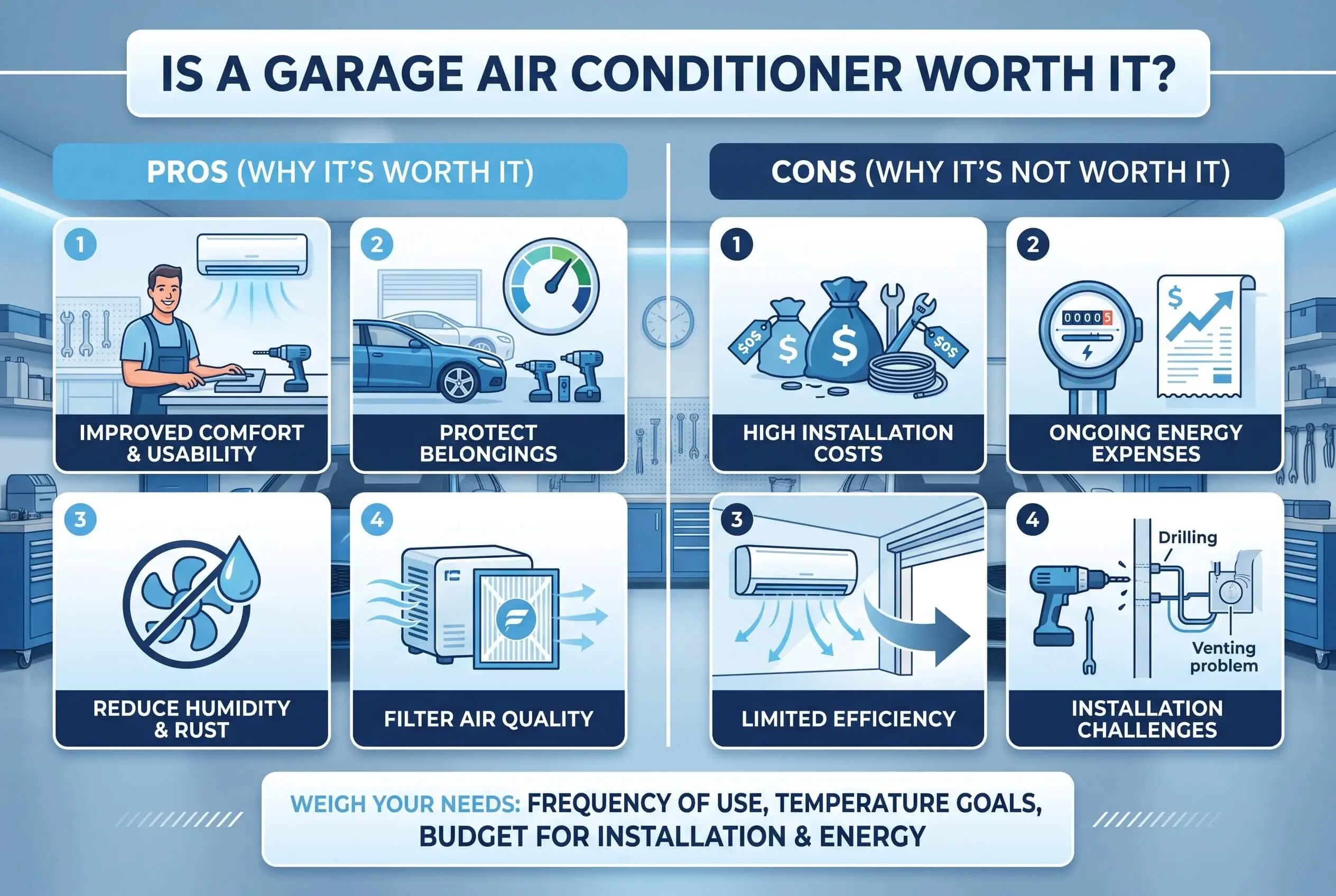
Insulate before you install. An uninsulated garage forces the equipment to run continuously, and that runtime becomes the operating cost homeowners later blame on the unit.
Price the electrical work before you price the air conditioner. Anything above 12,000 BTU generally needs a dedicated 230V circuit, and a full panel can cost more to fix than the cooling hardware.
Run it steadily instead of in bursts. Short hard cycles in humid climates put condensation on your slab and on stored metal. Moderate continuous operation avoids most of it.
Your hours of use decide the verdict. A garage you occupy several times a week justifies the spend. A garage you walk through does not.
A tighter garage needs more attention to combustion safety. Sealing the space means exhaust lingers longer, so never run an engine or a generator inside with the door down.
Why Your Garage Runs Hotter Than the Air Outside
Ninety-four degrees outside. A hundred and twelve inside. I've clipped a thermometer to the back wall of enough two-car garages to stop being surprised by that gap.
Here's what opens it up. The walls and the overhead door usually carry no insulation at all, so the sun's energy walks straight through the building materials. Your garage also sits outside the home's duct system, so nothing conditioned ever reaches it and nothing regulates the temperature. Then you park a warm car in there, often beside a water heater, a spare freezer, or a bench full of tools shedding heat of their own.
The room behaves like a battery. It charges all afternoon and gives the heat back slowly, which is why a closed garage can still feel stuffy at six in the morning. Pairing your cooling system with high quality air filters also helps support cleaner airflow and efficient HVAC performance throughout the home while you keep the garage comfortable.
What Cooling It Actually Buys You
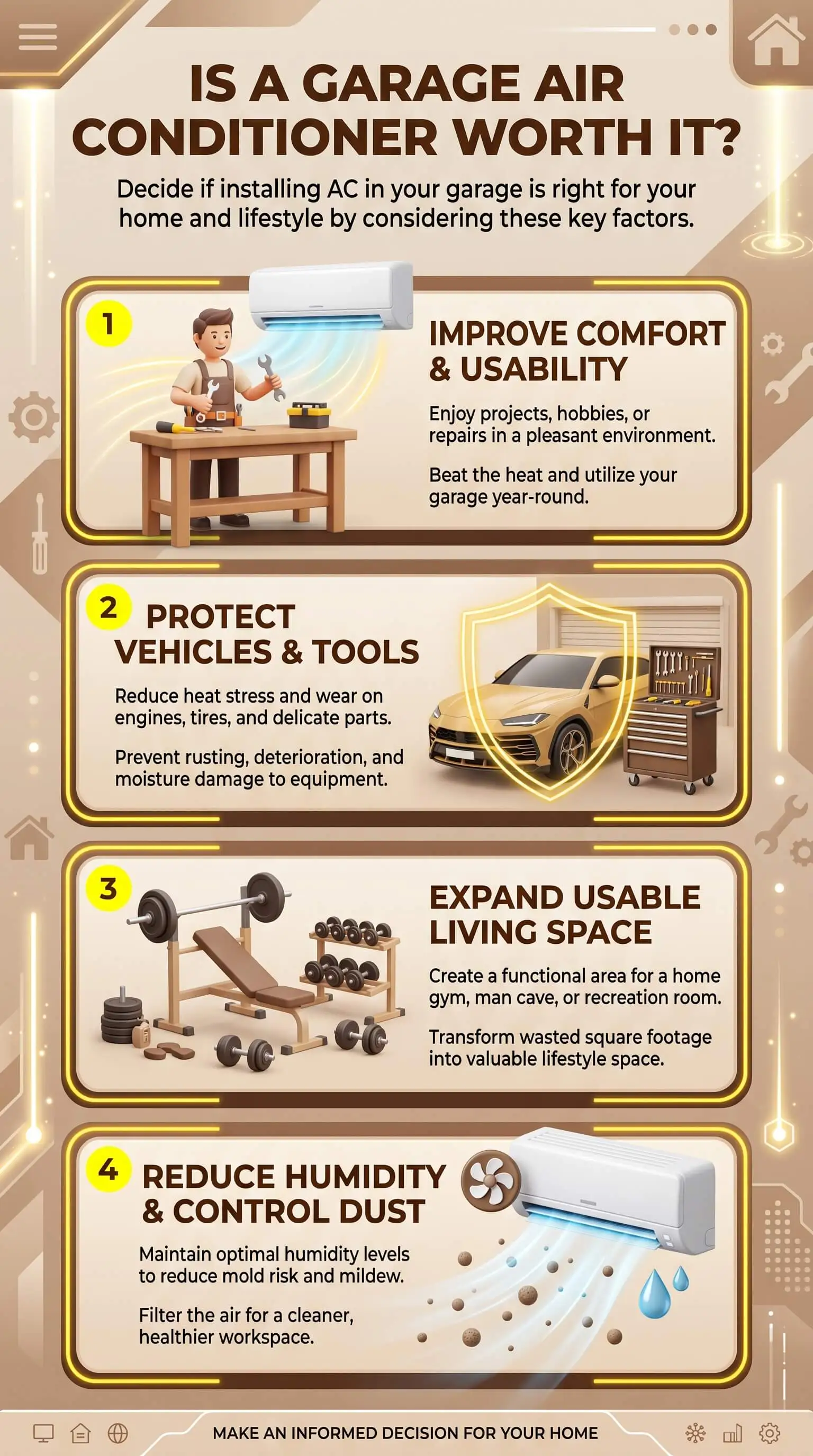
Square footage. That's the honest benefit, and it's bigger than most homeowners give it credit for, because a 400-square-foot garage is usually the cheapest floor space on the property to make usable. The shell already exists. You aren't building anything.
Every homeowner I've followed up with a year later told me the same thing had changed: they started using the room. Home gyms get used in July instead of March. Half-finished woodworking projects get finished. One client moved his small-engine repair side business out of a rented bay and into his own garage, and quit paying rent on it.
Then there's whatever you keep out there. Heat and humidity swings are brutal on hand tools, adhesives, paint, batteries, and anything with a rubber seal. I've pulled rusted chisels out of uncooled garages more times than I want to admit, along with wood glue that had separated in the bottle. Hold the space near 78 and most of that stops.
What Installation and Operation Cost
Equipment is the part homeowners price out on their own. A 12,000 BTU ductless system sized for a one-car garage typically runs $900 to $1,700 for the hardware, and professional installation on a straightforward run adds $1,000 to $2,200. Portable and window units cost far less up front and more to operate for the cooling they hand you.
The line item people miss is electrical. A 12,000 BTU unit might run on a standard 115V circuit. Almost anything larger needs 230V, and that means a dedicated circuit pulled from your panel. If the panel has no open slots, you're looking at a subpanel or a service upgrade, and that one item can outrun the price of the air conditioner itself. I ask to see the panel before I quote anything, because panel work can add $500 to $2,500 depending on what's waiting behind the cover.
Operating cost is the friendliest number in this conversation. A 12,000 BTU inverter system pulls somewhere around 700 to 900 watts while the compressor works, so six hours a day comes to roughly 4 to 5 kilowatt-hours. Multiply by your rate. For most of the homeowners I work with in Central Florida, a garage used a few evenings a week lands closer to a nice dinner out than to a second mortgage.
The Tradeoffs Worth Knowing About
Every one of these units works the same way, moving heat out of the room through a refrigerant cycle rather than manufacturing cold. Worth knowing, because air conditioning pulls moisture out along with the heat, and the moisture half is where garages get interesting.
In a humid climate, a cooled concrete slab sitting in warm outside air will sweat. I see it most often on one predictable pattern. Somebody runs the unit hard for two hours on a Saturday, shuts it off for six days, then opens the door and lets humid air rush back onto a cold floor. Condensation beads up on the slab and on every metal surface in the room. Steady, moderate operation causes far less grief than occasional blasts.
Insulation isn't optional if you care how the finished job performs. Cooling an uninsulated garage means paying to cool the neighborhood, and the equipment runs flat out trying to keep up. Insulating the overhead door and any exposed walls before the system goes in is the single change that does the most for your outcome.
Sealing a garage up tighter also raises the stakes on anything that burns fuel inside it. A tighter room holds exhaust longer. Running an engine or a generator in a closed garage is a genuine hazard rather than a theoretical one, and air sealing the wall you share with the house matters just as much, because a depressurized house pulls garage air straight into your living space.
Noise comes last, and it's minor with good equipment. A quality ductless head runs around 30 decibels on low. A portable unit sitting three feet from your workbench does not.
Choosing the Equipment
Once you've decided the space is worth conditioning, picking the equipment becomes its own project, and I'm not going to restage a walkthrough that already exists in more detail than I can fit here. This guide on how to cool a garage puts fans, ventilation, air sealing, insulation, portable units, window units, and ductless systems side by side, with BTU sizing worked out by garage size. Read it after you've answered the question this page is about.
When I Tell People Not to Bother
Four situations turn my answer to no.
The garage is storage. If you walk in twice a week for a bike and walk right back out, you're buying comfort you won't be there to enjoy. Insulate the door, add a fan, and keep the rest of your money.
You won't insulate first. I've watched homeowners wave off the insulation work, install the unit anyway, and then complain about the runtime and the power bill. They were right to complain. It was also avoidable.
Your panel has no room. When the electrical upgrade costs more than the cooling equipment, the math usually stops working, unless you were planning that upgrade for other reasons already.
The door stays open. Some people work with the overhead door up because they want the light and the airflow. No air conditioner competes with a 16-foot hole in the wall.
“After twenty-two years of service calls, I can tell inside a minute whether a garage system got sized before anybody bothered to insulate the overhead door. The unit runs nonstop, the homeowner blames the equipment, and the actual fix was one afternoon with a door kit.”
7 Essential Resources
Check Ductless Efficiency Against the Certification Data
ENERGY STAR's Ductless Heating & Cooling page names garages and outbuildings outright as good candidates for mini split equipment, and it explains why correct sizing beats buying big. Start here before you shop anything.
Understand the Carbon Monoxide Risk Before You Seal the Space
The EPA's page on carbon monoxide and indoor air quality is blunt about idling vehicles and running generators in garages. Anyone tightening up a garage should read it first, not afterward.
Keep Garage Air Out of Your Living Space
The Department of Energy's Building America guide to mechanical ventilation for an attached garage covers exhaust fan sizing, air sealing the shared wall, and self-closing doors. This one is the technical backbone for doing the job properly.
Recognize Heat Illness Before It Puts You on the Floor
NIOSH walks through heat-related illnesses including heat stroke, heat exhaustion, and rhabdomyolysis, and it covers the risk to people working indoors in hot environments. A 112-degree garage qualifies as one.
Know What Hazardous Heat Exposure Looks Like
OSHA's overview of working in outdoor and indoor heat environments documents how heat degrades fine motor performance even in people used to it. If you do precision work at a bench, that finding lands close to home.
Look Honestly at Your Electrical Situation
The NFPA's guidance on electrical safety in the home is the right starting point before anybody adds a dedicated circuit for cooling equipment. Hand the panel work to a licensed electrician.
See Your Garage the Way an Inspector Sees It
InterNACHI's Home Inspection Standards of Practice spell out what a professional examines in a garage, from the overhead door to the shared walls and the firewall separation. Use it as a checklist for catching problems before they undercut your cooling.
Choosing the best HVAC system for a garage starts with understanding the space itself. Trusted resources on efficiency, ventilation, electrical safety, and heat exposure help ensure your cooling system is properly sized, safely installed, and built to perform for years to come.
3 Statistics
Air conditioning accounted for about 19 percent of the electricity used in U.S. homes in 2020, roughly 254 billion kilowatt-hours, according to the U.S. Energy Information Administration. Adding a garage to your cooled floor area moves your own slice of that number, which is precisely why the insulation work pays for itself.
Of new single-family homes sold in the South in 2024, 75 percent came with a two-car garage, per the U.S. Census Bureau's Characteristics of New Housing. Most homeowners in hot climates already own the shell of a 400-square-foot room they can't use half the year.
The contiguous United States averaged 54.6 degrees in 2025, running 2.6 degrees above the twentieth-century average and ranking fourth warmest in 131 years of records, reports NOAA's National Centers for Environmental Information. The window when a garage stays comfortable on its own keeps getting shorter.
Air conditioning efficiency depends on more than insulation and sizing. As garage cooling demand grows, keeping systems maintained with clean, high-quality components such as pleated furnace filters helps support proper airflow and overall HVAC performance throughout the home.
Final Thoughts and Opinion
Here's where I land after enough of these jobs to have earned an opinion. A garage air conditioner is worth it when you spend actual hours in the space, when you insulate the door and walls before the equipment shows up, and when your panel has capacity to spare. Meet those conditions and it's one of the better returns available in home comfort, because you're converting square footage you already own instead of building new.
Miss one of them and I'd rather you waited. The homeowners who end up unhappy are almost never unhappy with the concept. They're unhappy because they bought equipment to solve a building envelope problem, or because surprise electrical work turned a $2,500 project into a $5,000 one. Fix the envelope, price the electrical honestly, then buy the unit. While you're improving your home's HVAC system, upgrading to a MERV 8 pleated HVAC air filter is another smart investment that supports cleaner airflow, helps protect your equipment, and keeps your system operating more efficiently. In that order, I haven't yet watched anybody regret it.
Frequently Asked Questions
How much does it cost to run a garage air conditioner?
A 12,000 BTU inverter unit pulls roughly 700 to 900 watts while the compressor works, which comes to about 4 to 5 kilowatt-hours across a six-hour day. Multiply by your utility rate. Insulation quality moves that answer far more than the choice of equipment does.
Will a portable air conditioner cool my garage?
In a small, sealed, insulated garage, yes. In an uninsulated two-car space it usually loses the fight. Portables also eat floor space you probably want for work, and they exhaust through a hose that needs an opening to the outside.
Do I really have to insulate my garage first?
You can skip it. I've watched plenty of people do exactly that, and the result is a unit that never shuts off, a higher bill, and a room that still struggles on the worst afternoons. Insulating the overhead door delivers the most value for the least money.
Will a garage air conditioner work with the door open?
No. An open overhead door is a hole roughly the size of a small wall, and no residential cooling equipment keeps up with that. If you need the door open for light or airflow, put your money into ventilation and fans instead.
Does a garage air conditioner need its own circuit?
Usually, yes. Smaller 115V units can sometimes share an existing circuit, though I don't recommend it. Anything at 18,000 BTU or above needs 230V on a dedicated circuit, and that work belongs to a licensed electrician who has looked inside your panel.
Will cooling my garage cause condensation on my tools?
It can, if you run the unit in short hard bursts and then let humid air back in. Steady moderate operation keeps the slab and the air closer in temperature, which prevents most sweating. A dehumidifier helps through the wettest months.
Your Next Step on a Garage Air Conditioner
Walk your garage with a thermometer and write down how many hours a week you honestly spend out there. That number, sitting next to the condition of your insulation and the open slots in your panel, tells you more about whether cooling makes sense than any spec sheet will, including standard HVAC air conditioner sizes for home, because garages have unique heat loads that often require different sizing considerations.