The number worth watching is 101. That's when the Mid-Ohio Regional Planning Commission (MORPC) issued an Air Quality Alert for Central Ohio.
What the outdoor reading can't show you is the air inside your house, where your family breathes most of the day. Knowing what's typical for air quality in Columbus Ohio tells you when to take precautions, and a few AC changes keep indoor air cleaner when the reading climbs.
TL;DR Quick Answers
air quality Columbus Ohio
Air quality in Columbus, Ohio is usually Good to Moderate, with an AQI between 0 and 100 on most days. Summer ozone and wildfire smoke cause most of the exceptions, and MORPC issues an Air Quality Alert at 101. You breathe most of your air indoors, so your AC settings decide how much of that outdoor air reaches your family.
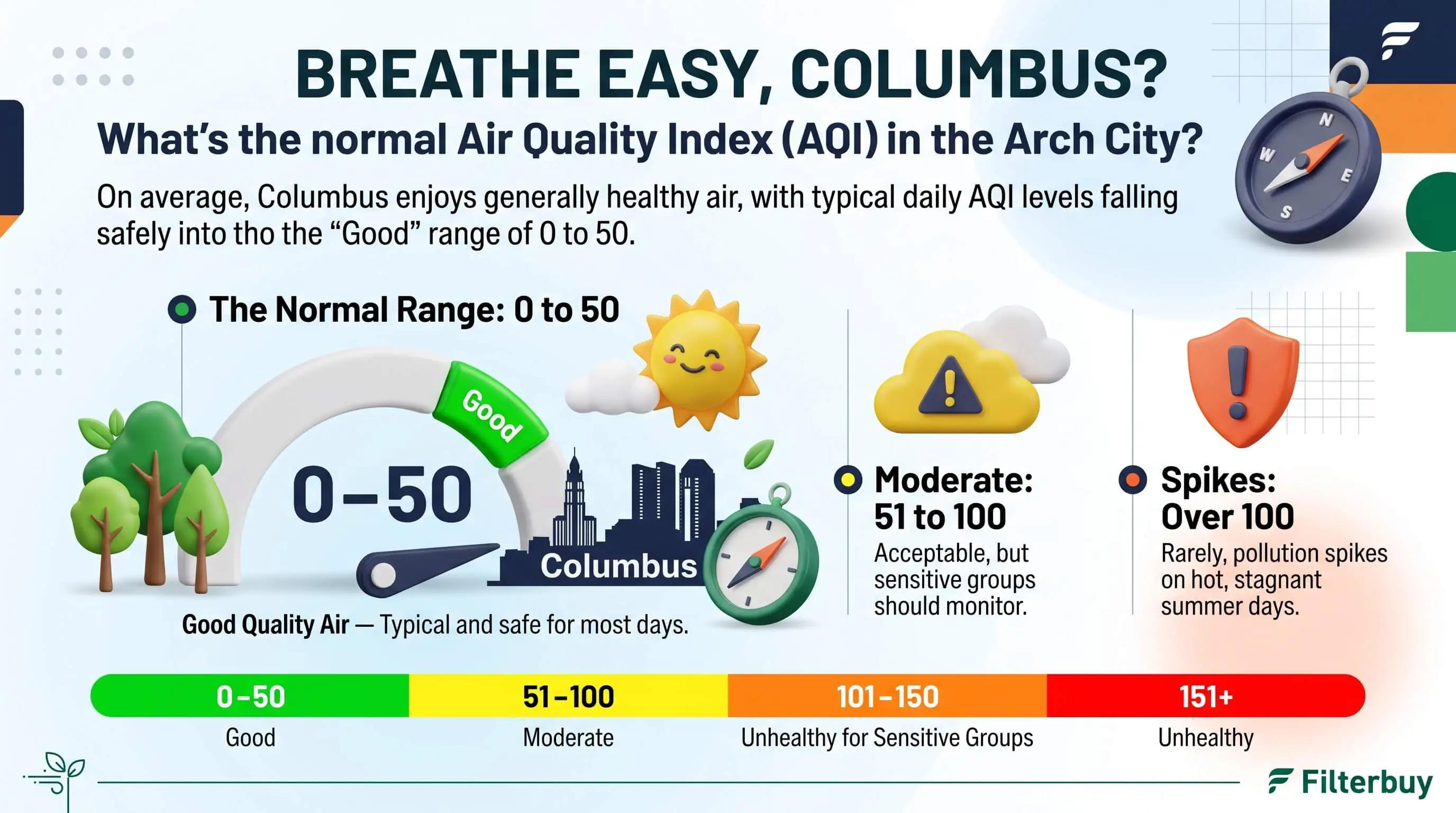
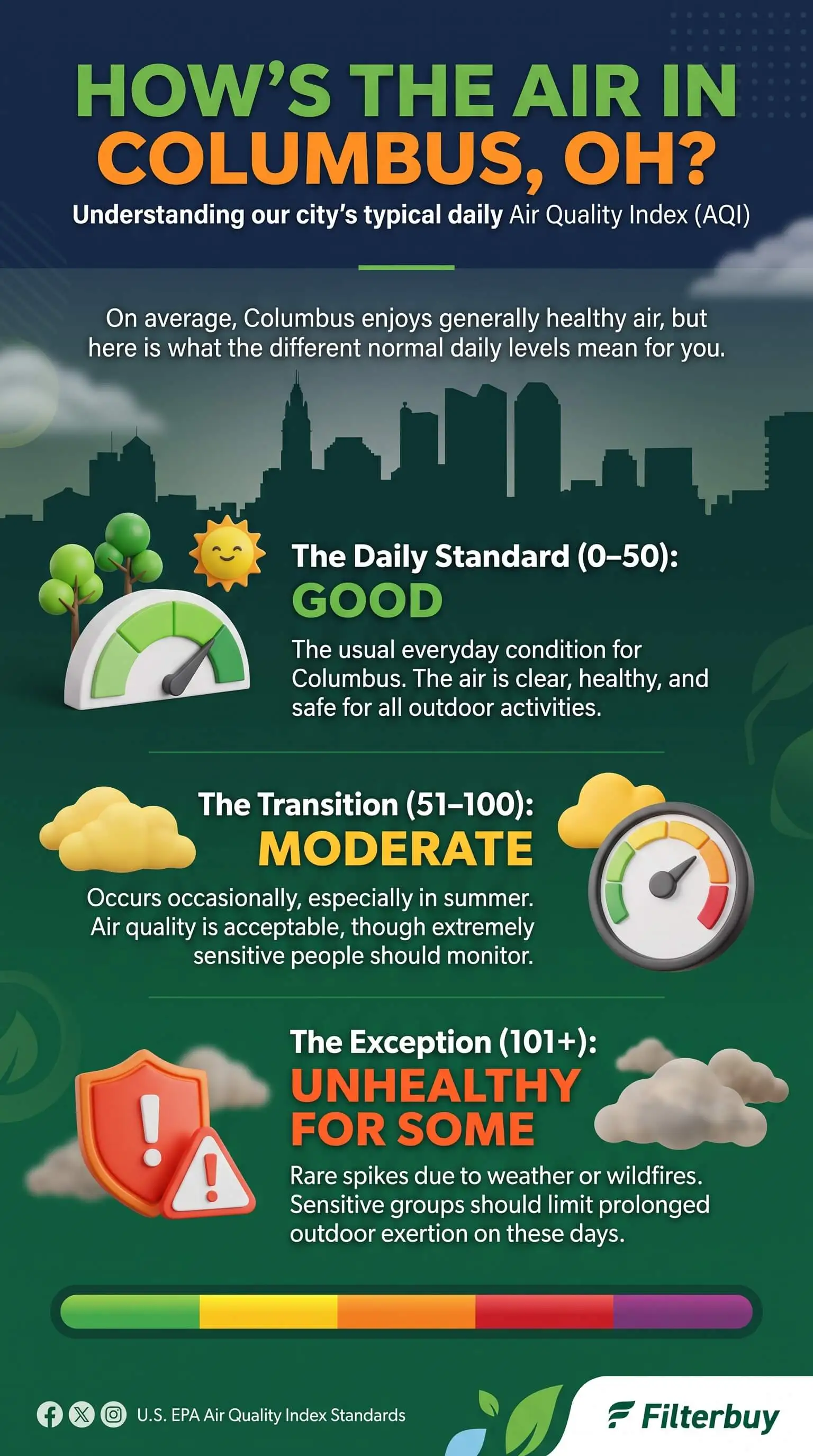
Normal range: An AQI of 0 to 100, the Green and Yellow bands, is typical for Columbus.
Alert threshold: MORPC issues an Air Quality Alert for Central Ohio when the forecast reaches 101 or higher.
Recent record: Franklin County averaged 4.8 unhealthy particle days and 1.7 unhealthy ozone days a year, according to the American Lung Association’s 2026 State of the Air report.
Seasonal pattern: Ozone builds on hot, still summer afternoons, and fine particles spike when wildfire smoke drifts in.
Indoor move: On alert days, keep the windows shut and switch the thermostat fan from Auto to On so air keeps passing through the filter.
Top Takeaways
Columbus, Ohio considers an AQI of 0 to 100 normal, and most days stay in that range.
MORPC issues an Air Quality Alert when the forecast reaches 101 or higher.
A stricter PM2.5 cutoff since May 2024 means more Yellow days without dirtier air.
Franklin County averages 4.8 unhealthy particle days and 1.7 unhealthy ozone days a year.
On alert days, close up the house, set the fan to On, and run the best filter your system supports.
How the Air Quality Index Works
The Air Quality Index boils several pollutants down to one score between 0 and 500. The higher it climbs, the more your lungs have to deal with. EPA set up the scale so that 100 roughly matches the federal health standard for each pollutant.
The Six AQI Color Bands
Green (0 to 50), Good: Little or no risk, so get outside and enjoy it.
Yellow (51 to 100), Moderate: Fine for nearly everyone, though unusually sensitive people may notice symptoms.
Orange (101 to 150), Unhealthy for Sensitive Groups: Children, older adults, and anyone with asthma, COPD, or heart disease should ease up outdoors.
Red (151 to 200), Unhealthy: Everyone may start to feel it.
Purple (201 to 300), Very Unhealthy: A health alert for everyone.
Maroon (301 to 500), Hazardous: Emergency conditions.
Why the Worst Pollutant Sets the Number
Columbus monitors track ground-level ozone, fine particles known as PM2.5, and a few other pollutants. Whichever one scores worse becomes the AQI you see. EPA's AirNow weights the latest hours most heavily through a method called NowCast, so the reading moves fast when conditions change.
What Normal Air Quality Looks Like in Columbus
A Typical Columbus Day
Most Columbus days read Green or Yellow. For the average family, Yellow means one pollutant has crept above the cleanest range, and that's rarely a reason to cancel the Saturday soccer game.
If Yellow seems to show up more often lately, you're not imagining it. In May 2024, EPA dropped the PM2.5 Good cutoff from 12.0 to 9.0 µg/m³, a change its PM2.5 Air Quality Index fact sheet spells out. EPA tightened the yardstick, so air that once read Green can now land in Yellow without getting any dirtier.
How Often Columbus Air Turns Unhealthy
Bad air days are rare here, but the fine particle numbers are heading the wrong way. The American Lung Association's 2026 State of the Air report, built on 2022 to 2024 data, gave Franklin County an F for short-term particle spikes at 4.8 unhealthy days a year and a C for ozone at 1.7 days. Columbus slid to 34th worst in the nation for those spikes, even though its year-round particle average still meets the federal standard.
Why Columbus Air Quality Changes With the Seasons
Summer Ozone Days
Ozone cooks up on hot, still afternoons, when exhaust from cars, trucks, and gas mowers reacts in the sunlight. MORPC tracks ozone from March through October, and most summer alerts land on those heavy, windless days. July 2026 brought several, as heat and thin wildfire smoke pushed forecasts past 100.
Winter Fine Particle Days
Fine particles never take a season off. In the cold months, wood smoke, diesel exhaust, and calm, frosty nights keep particles hanging low until daytime warmth stirs the air again.
Wildfire Smoke Days
Smoke from Canada and the western states can push Columbus readings up on a day when nothing local has changed. Those are the days Columbus has its best odds of hitting Red.
When to Take Precautions in Columbus
Green: Go ahead with your outdoor plans.
Yellow: Most people carry on as usual. If you're unusually sensitive, watch for a cough or shortness of breath.
Orange: Sensitive groups should keep outdoor exertion shorter and lighter, take more breaks, and keep quick-relief medicine close.
Red and above: Everyone should cut back, and sensitive groups should take activity indoors.
On ozone days, plan around the clock. Mornings usually bring the cleanest air because ozone builds as the afternoon heats up.
How to Check Columbus Air Quality Today
A live Columbus air quality map shows today's reading and the pollutant behind it, the quickest check before a run or yard work. MORPC also emails free Air Quality Alerts the evening before any day forecast to reach 101 or higher. While these tools help you monitor outdoor conditions, it's also worth taking steps to test indoor air quality and understand what you're breathing inside your home.
Using Your AC System on High AQI Days
Closing the windows only gets you partway. Fine particles still slip in through gaps and fresh-air intakes, and your AC system is the best tool you own for catching them. Here's what I'd do on Orange, Red, or smoke days:
Close up the house: Keep windows and doors shut and let the AC recirculate indoor air.
Switch the fan to On: Auto runs the blower only while the system heats or cools. It keeps air moving through the filter around the clock.
Set fresh-air intakes to recirculate: If your system has an outdoor air damper, close it until the reading drops.
Use the highest-rated filter your system supports: CDC recommends MERV 13 or higher when your system can handle it. A filter too dense for your blower can choke airflow, so check your specs or ask an HVAC technician first.
Swap a loaded filter once the smoke clears: A filter that worked through a smoke event has less left for the next one.
"In the Columbus homes I've serviced, the thermostat fan lets families down on bad air days far more often than the filter rating does. On mild spring and fall smoke days the system isn't calling for heat or cooling, so the blower can sit idle for hours, and even a MERV 8 filter cleans almost nothing until someone flips the fan to On."
7 Essential Resources
Live Columbus Air Quality Map: Today's AQI and the pollutant driving it, linked in the section above.
EPA AirNow, Ohio: Federal readings and forecasts for every Ohio reporting area. airnow.gov/state/?name=ohio
MORPC Air Quality Program: Central Ohio forecasts, alerts at AQI 101 and above, and the free email sign-up. morpc.org/programs-services/air-quality
Ohio EPA Air Monitoring Network Plan: Where the state keeps its Columbus ozone and PM2.5 monitors. Ohio EPA 2025-2026 Network Plan (PDF)
Franklin County Public Health: Local air monitoring plus Healthy Homes inspections that check ventilation. myfcph.org/sustainability
CDC Wildfire Smoke Safety: How to set up a clean room, upgrade your HVAC filter, and keep smoky outdoor air out. CDC wildfire safety guide
Asthma and Allergy Foundation of America, 2025 Asthma Capitals: How Columbus ranks among 100 U.S. cities for asthma. AAFA 2025 Asthma Capitals report (PDF)
3 Statistics
4.8 unhealthy particle days a year: From 2022 to 2024, Franklin County averaged 4.8 unhealthy short-term particle days and 1.7 unhealthy ozone days each year. American Lung Association, 2026 State of the Air, Ohio
2 to 5 times higher indoors: Americans spend about 90 percent of their time indoors, where some pollutants run 2 to 5 times higher than typical outdoor levels. EPA Report on the Environment, Indoor Air Quality
First Unhealthy rating in 20 years: Canadian wildfire smoke drove Central Ohio's AQI to 164 on June 28, 2023, its first Unhealthy reading in two decades. WOSU Public Media
Final Thoughts
Normal in Columbus is mostly good news, with Green and Yellow covering the vast majority of days and year-round particles meeting the federal standard. I'd still keep a close eye on the short-term particle spikes, because smoke and stagnant air keep driving them up.
My advice is to treat Yellow as information and Orange as your cue to act indoors. The outdoor number tells you when. How much of that air your family actually breathes comes down to your AC system and the way you set it up.
Frequently Asked Questions
Is an AQI of 50 Good in Columbus?
Yes. Fifty sits at the top of the Green band, so the air is satisfactory and carries little or no risk. Sensitive groups included, it's a good day to be outside.
Is an AQI of 100 Bad for You?
For most people, no. One hundred is the top of the Yellow band and roughly matches the federal health standard. Concern for sensitive groups starts at 101, when MORPC issues an Air Quality Alert.
Why Is Columbus Air Quality Worse in Summer?
Heat and sunshine make ozone. Exhaust from vehicles and gas-powered lawn equipment reacts in hot, still air, and ground-level ozone peaks in the afternoon. That's why most Columbus Air Quality Alerts arrive during summer heat.
Should I Run My Air Conditioner When Air Quality Is Bad?
Yes. Keep the windows closed, let the AC recirculate indoor air, and switch the thermostat fan from Auto to On so air keeps passing through the filter. If your system has a fresh-air intake, set it to recirculate until the reading drops.
Do Air Purifiers Help on Air Quality Alert Days?
A portable air cleaner sized for the room can noticeably cut fine particles, especially during smoke. CDC suggests setting up one clean room, often a bedroom, with the air cleaner running and the doors and windows shut.
Know Your Normal Before the Next Alert
A normal air quality index for Columbus, Ohio sits between 0 and 100, and once you know that baseline, every higher reading becomes easier to act on. Check today's reading and sign up for MORPC alerts, then give your AC system the filter and fan settings that keep your family's indoor air on the right side of that line. Choosing the best air filter for dust helps capture airborne particles and maintain cleaner air inside your home.


